How the city consistently praised for its efficient infrastructure plans to meet sustainable heating needs and the challenges it will face.
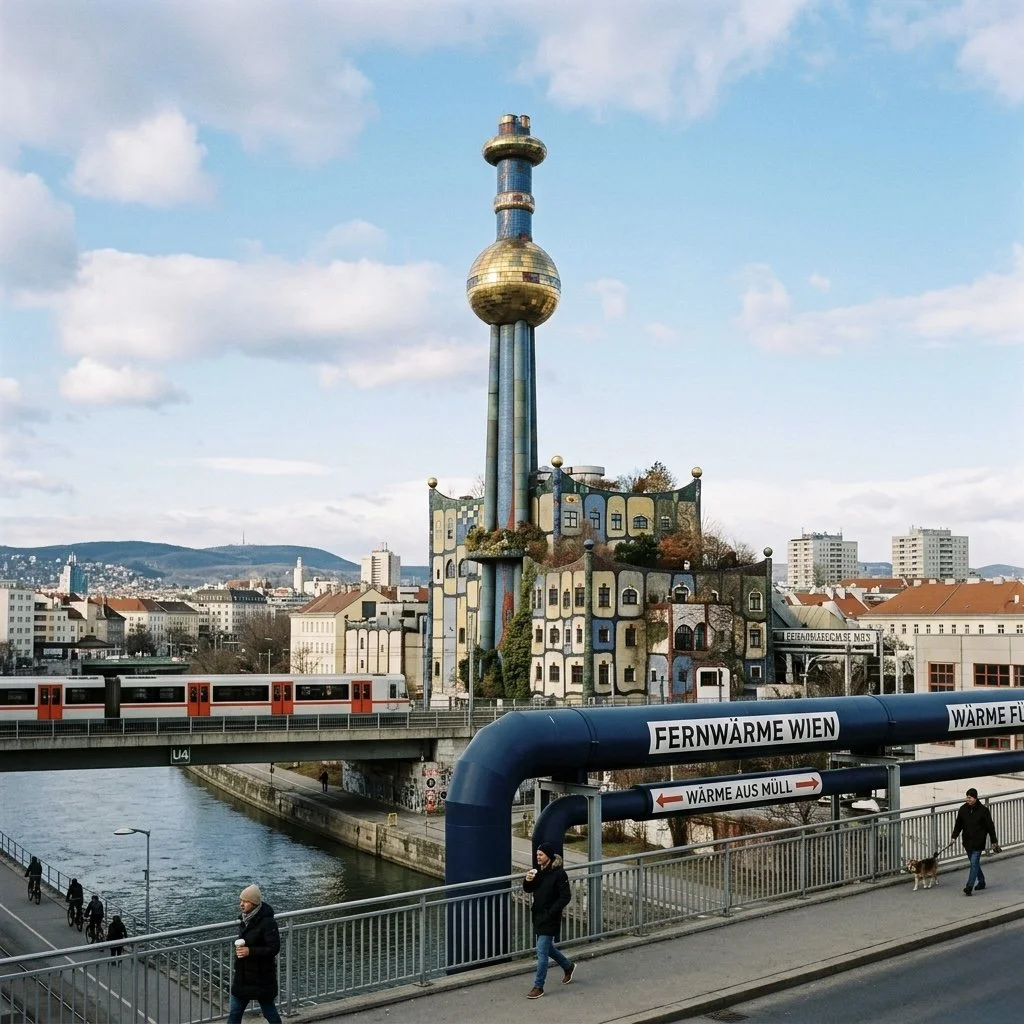
Vienna, among its other infrastructure successes, has created a robust and comprehensive district heating network covering much of the city. Heat, in the form of pressurized steam, travels through the city heating homes and businesses in a centralized and efficient way.
Vienna’s use of district heating dates back several decades. Concrete plans for centralized heat began to form in the 1960s, with Heizbetriebe Wien, the city’s original heating company which would later morph into Wien Energie, incorporating in 1969. By 1978, Vienna’s first heating transport pipelines were operational, and by 2000, Vienna achieved a major sustainability and energy efficiency goal: integrating one of its waste treatment facilities, which generates heat via waste processing and incineration, into the district heating network. This way, heat from processing and incinerating waste would not be lost but instead used for heating the city in an effective and efficient manner.
Effective district heating requires structural density. Where buildings and people are physically close, heat pipes can bring heat around a city with relatively low energy losses compared to places in which buildings are spread out. In these less compact areas, more heat escapes during transit and is lost. For this reason, Vienna is the most primed region in Austria to promote and upgrade its district heating. With its high urban density compared to other federal provinces, Vienna has the lowest per capita costs for space and water heating of any province, largely due to its use of district heating.
While Vienna’s district heating system is a remarkable work of infrastructure on its own, the system also fits into the city’s and country’s broader plan of increasing sustainability and decreasing dependence on fossil fuels. The City of Vienna has laid out an ambitious goal for itself: phase out gas and oil for heating by 2040. Like any large goal involving major infrastructure changes, this plan is easier said than done.
As in so many contexts, Vienna’s beauty and wonder have the potential to impede its progress. Designing new buildings for compatibility with a centralized district heating system is relatively easy. New construction can be built energy efficiently with tie-ins to district heating systems. Vienna, especially in its densest areas, however, is not a city of predominantly new buildings and energy efficient construction but of old historic architecture and grandeur dating back centuries. Rich in character - rich in energy consumption. These old buildings often feature gas-fired heating systems, which are challenging for sustainability goals in two ways: First, they definitionally use natural gas or in some cases other fossil fuels. Second, they aredecentralized, which means that changing them will require individually replacing building components with interconnection to the district heating system. The problem of connecting Vienna’s heating system is an issue both of energy efficiency and of energy connection.
The goal is simple but implementation is not. For the first challenge, denser areas require one solution, interconnection to the district heating network, while less dense areas require another, replacing traditional gas heaters with more efficient alternatives such as heat pumps. Another challenge is replacing the main sources of heat in centralized facilities; for Vienna to achieve fully renewable heat the central plants must generate heat from waste and renewables. For a third, construction of new facilities and heating infrastructure must remain compatible with the existing structural landscape of the city. All of these challenges are to some degree surmountable, but they require careful planning and foresight to ensure that they will be successful. Vienna has a goal to transition to fully renewable heat by 2040, and through careful planning and deployment, it has the potential to make substantial progress toward that mark.
Vienna is said to have a sense of awe running through its veins. Historically, the city has connected people through the wonder and intellectual depth of its architecture, art, natural beauty, food, and so much more. Connecting the city in a physical sense, however, remains the challenge and the goal of the present as the solution to meeting sustainable modern demands flows just beneath the surface.